
Project team: Chanakan Chormai, Diego Zambrano, Fleur Francesca Varel, and Aayushi Vasnik
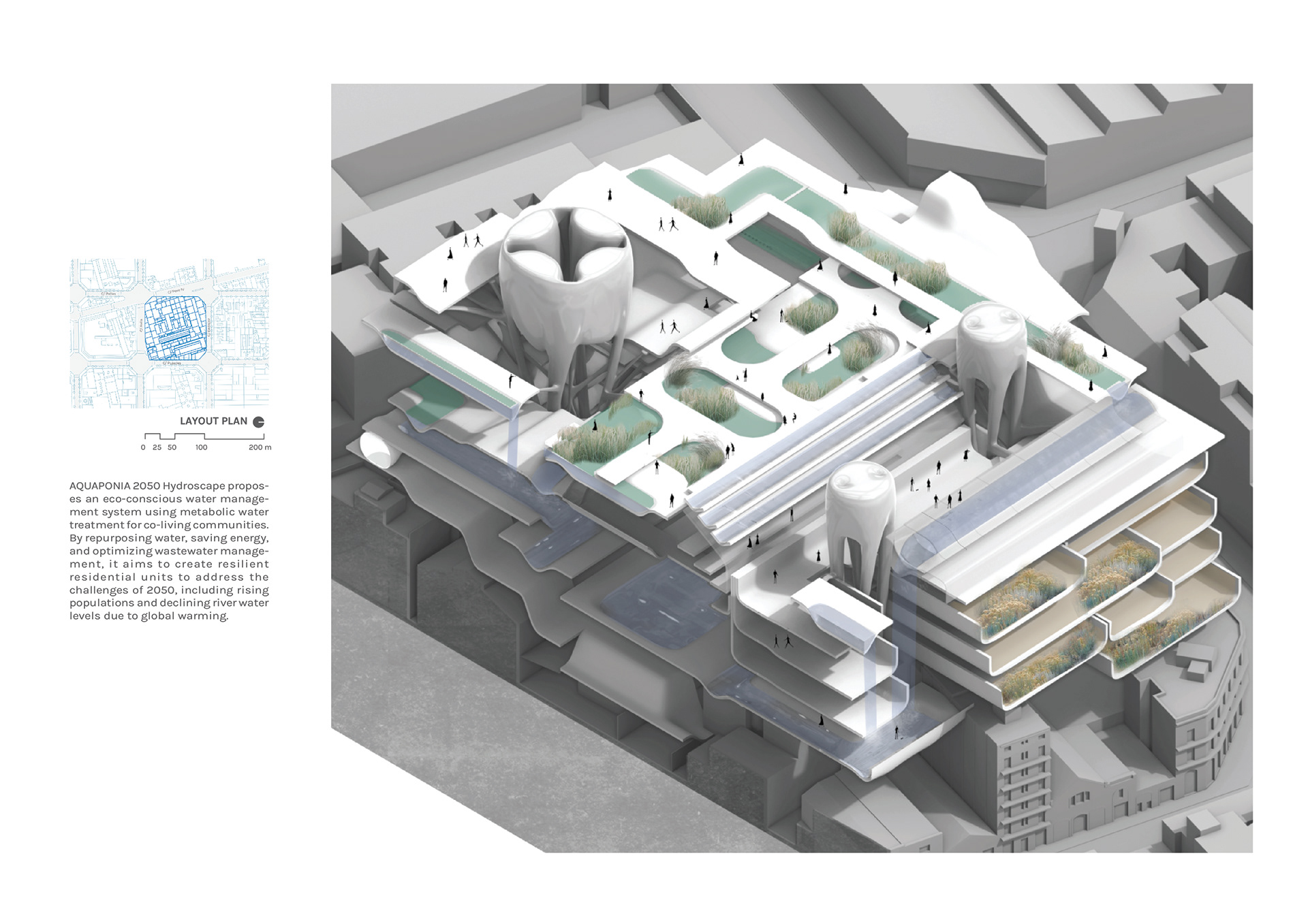
A speculative urban design project addressing future water resilience in Barcelona.
Investigated how co-living housing typologies could integrate into the city’s water cycle by reusing, channeling, and purifying water for various purposes — from drinking and leisure to building cooling. Developed a Sankey diagram-based system map to trace water flows through architectural and urban systems. The project combined scenario planning, data mapping, and visual storytelling to envision water-resilient futures for the city.
Investigated how co-living housing typologies could integrate into the city’s water cycle by reusing, channeling, and purifying water for various purposes — from drinking and leisure to building cooling. Developed a Sankey diagram-based system map to trace water flows through architectural and urban systems. The project combined scenario planning, data mapping, and visual storytelling to envision water-resilient futures for the city.
Research & Methodology
This project began with extensive research into Barcelona's water infrastructure vulnerabilities and projected 2050 climate scenarios. Through site analysis of existing water systems and mapping current consumption patterns, I identified a critical insight: downscaling water systems to the superblock level could create resilient alternatives to centralized infrastructure while expanding water's role beyond daily necessities to include planting, cooking, gardening, and leisure activities. The methodology combined quantitative data analysis with speculative design thinking to develop actionable housing and water management strategies that transform water from a utility into a community asset.
Systems Thinking Approach
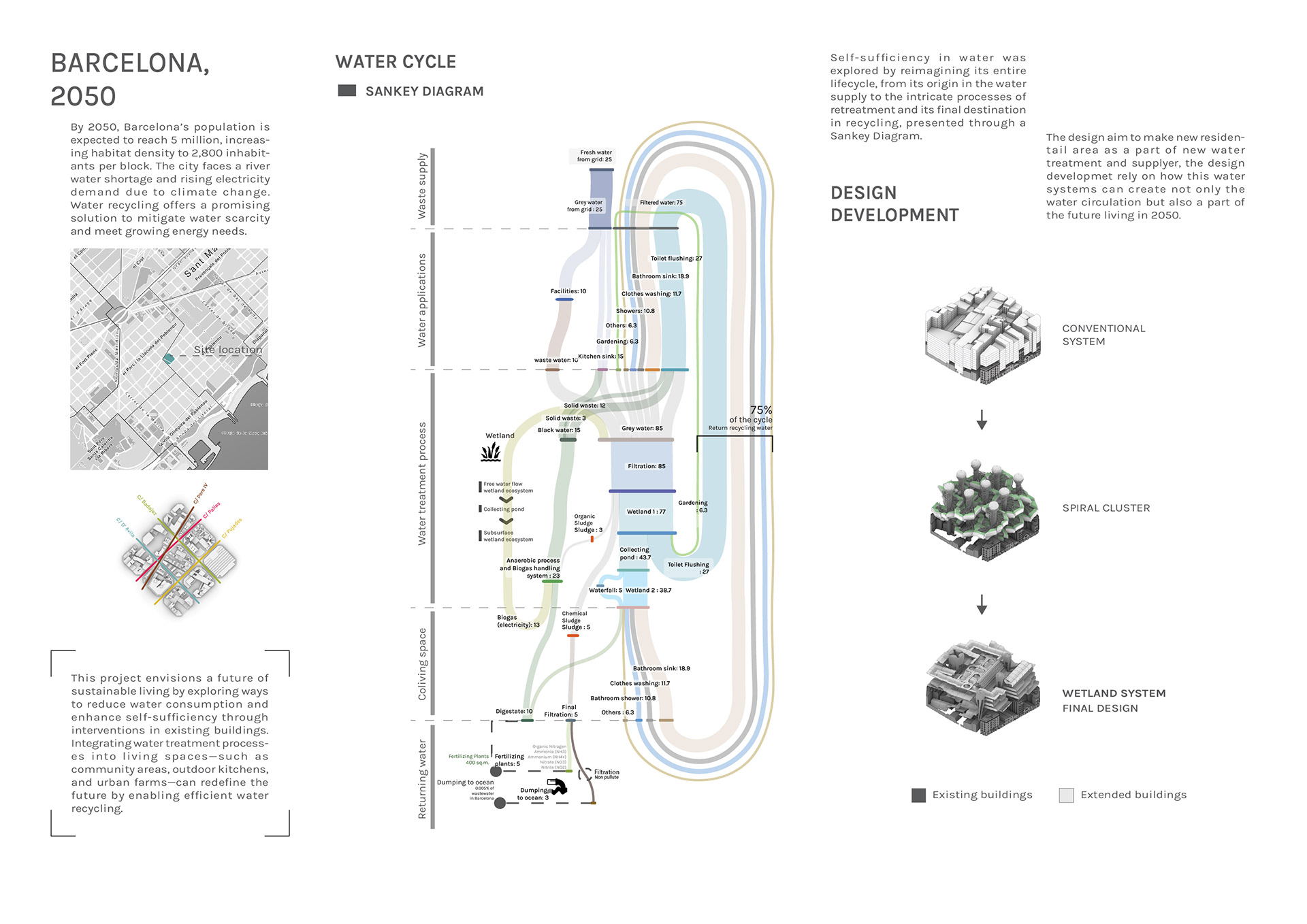
The Sankey diagram became the core analytical tool for understanding complex water relationships across scales — from individual housing units to neighborhood networks. This visualization method revealed hidden inefficiencies and potential symbiotic relationships between different water uses, enabling the design of closed-loop systems that transform waste into resources.
Co-living Integration Strategy
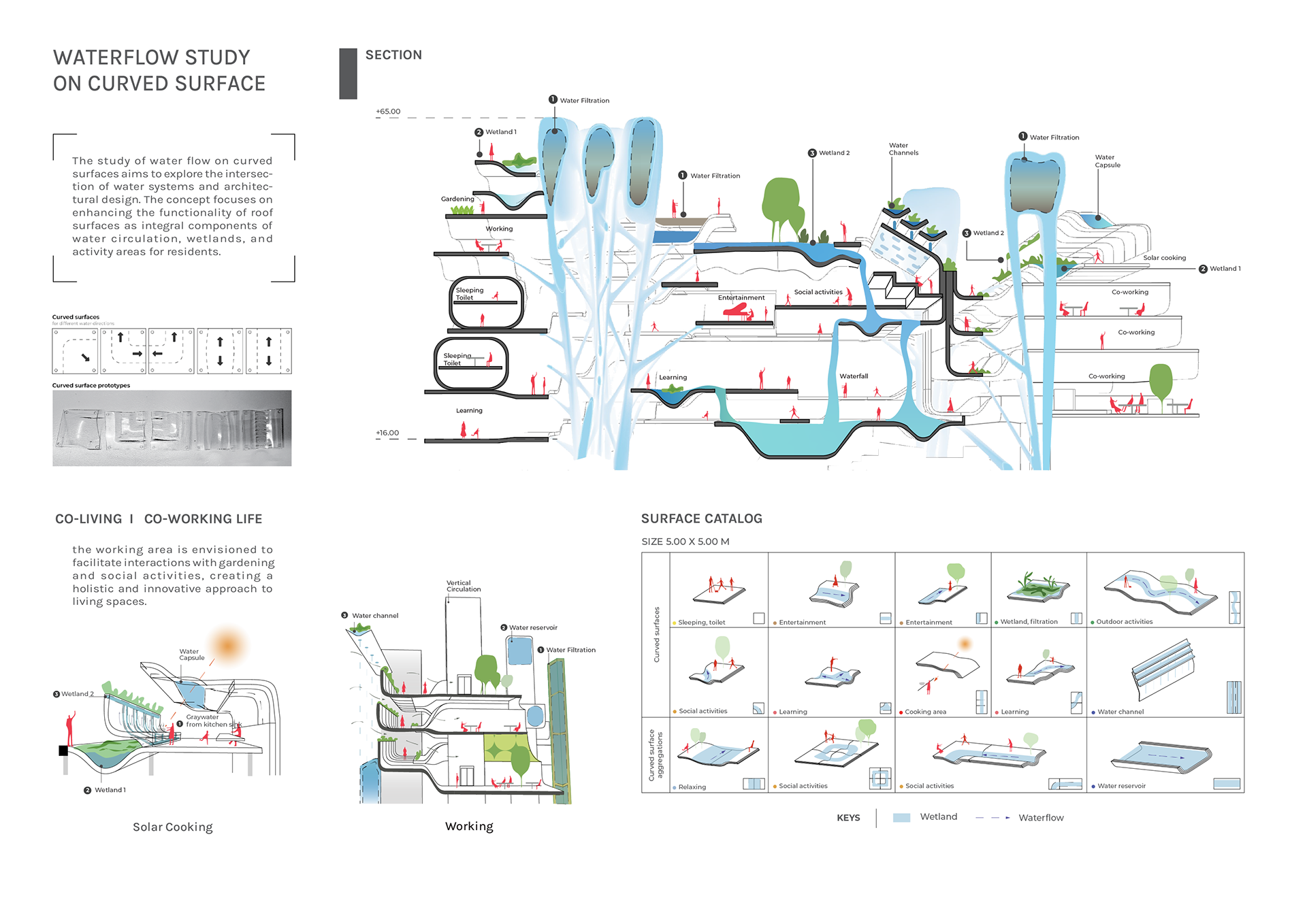
Rather than treating water management as separate infrastructure, the project embedded water systems directly into social spaces. Co-working areas double as greywater processing zones, community kitchens incorporate rainwater collection, and shared gardens become natural filtration systems. This integration transforms residents from passive consumers into active participants in water stewardship.
Scalability Framework
The design addresses three interconnected scales: individual housing units (micro-interventions), building clusters (community systems), and neighborhood networks (urban infrastructure). Each level builds upon the others, creating a resilient water ecosystem that can adapt to varying population densities and climate conditions.
For research details, read more