
★ Selected Founder, UNDP Climate Catalyst (Asia-Pacific), 2026
★ Selected for exhibition, Bangkok Design Week 2026
★ Special Award, Digital Urban Landscapes Thesis Cluster, Master in Advanced Architecture II, IAAC Barcelona, 2025
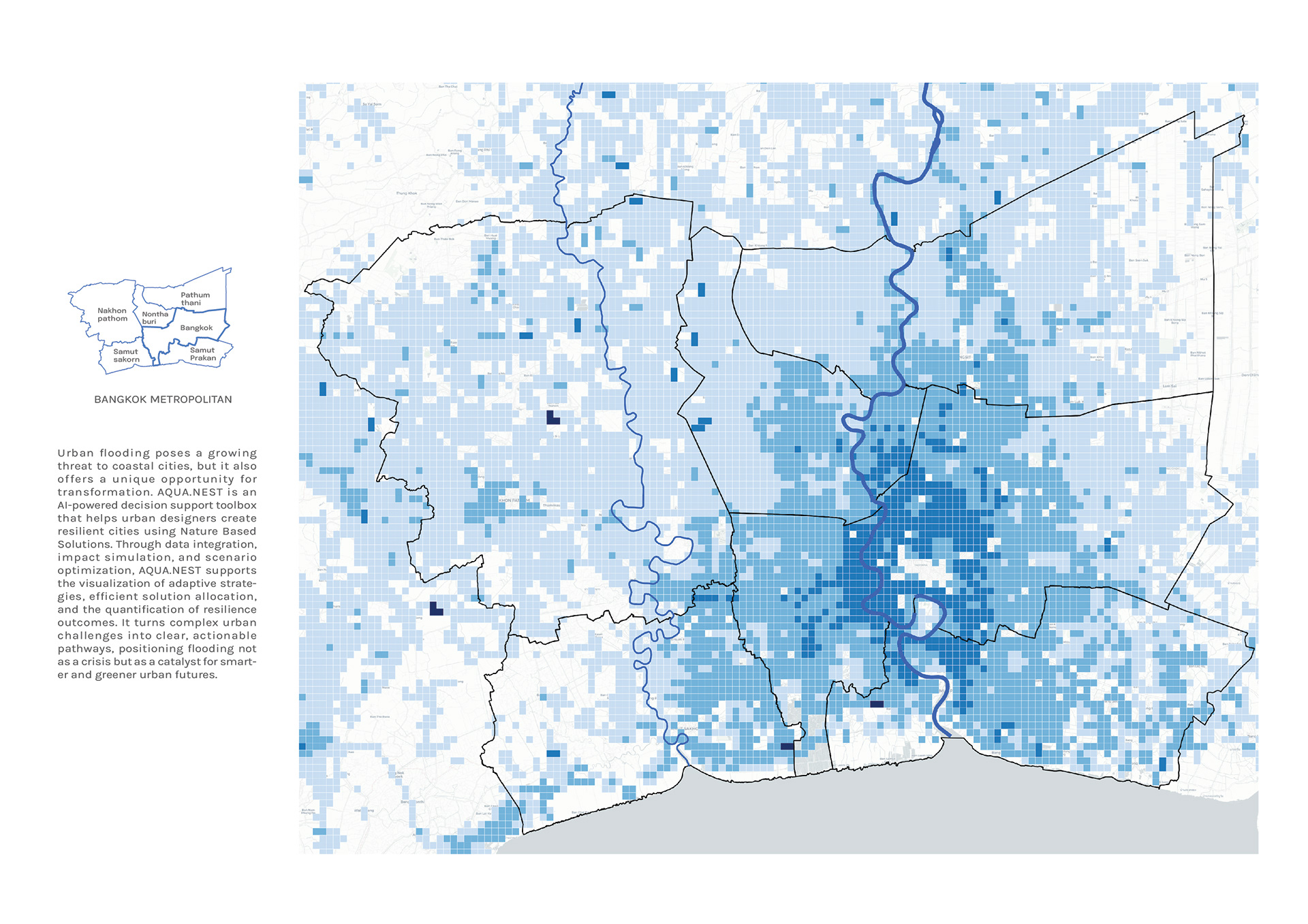
AQUA.NEST: An AI-Powered Decision Support Toolbox for Adaptive Urban Design Using Nature-Based Solutions in Flood-Exposed Coastal Cities is a research project addressing the growing threat of urban flooding in coastal cities while seeing it as an opportunity for transformation. The toolbox integrates data, simulates impacts, and optimizes scenarios to support adaptive urban design. By turning complex challenges into clear, actionable pathways, it positions flooding not as a crisis but as a catalyst for smarter and greener urban futures.
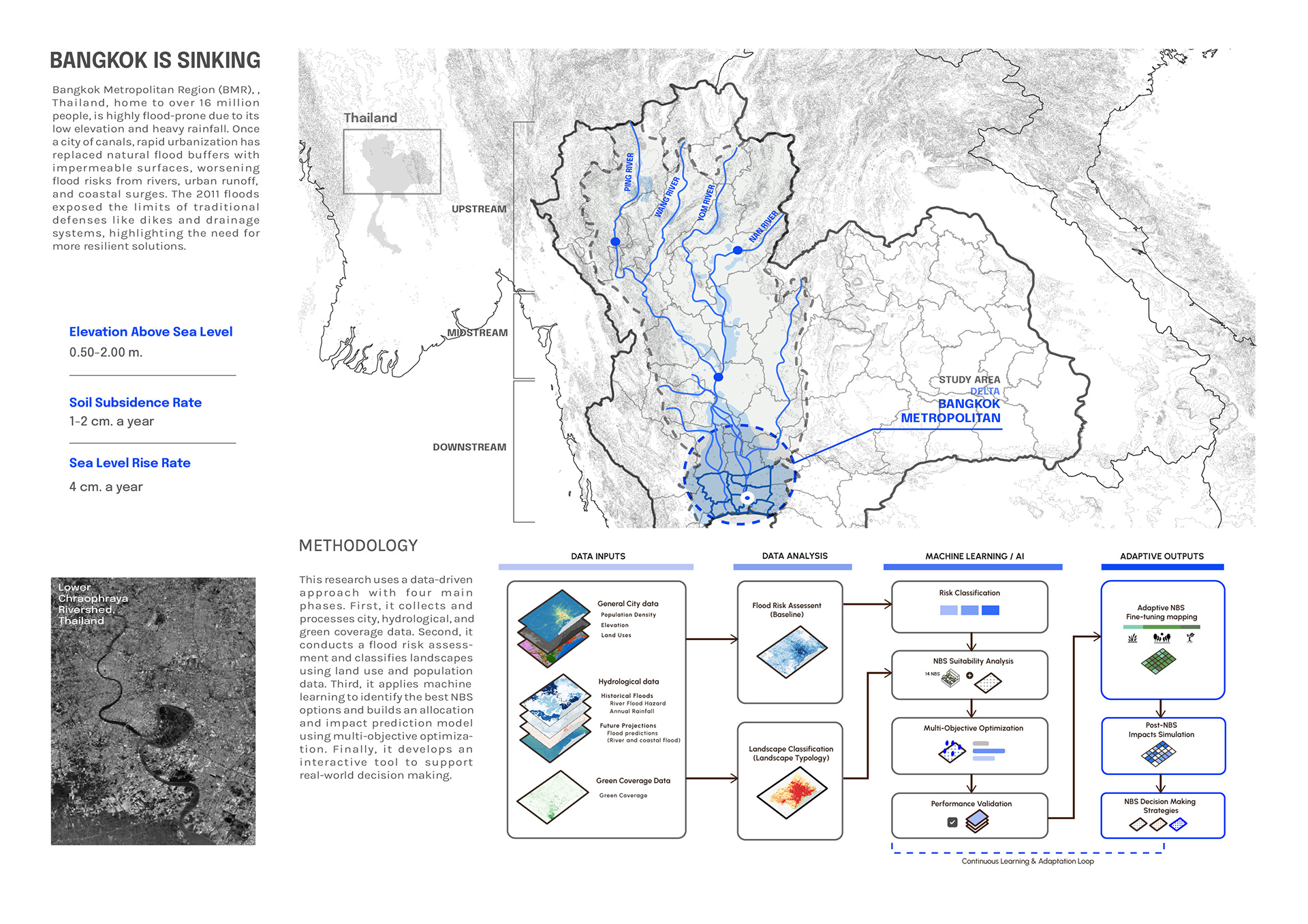
This project follows a data-driven methodology in four phases. First, city, hydrological, and green coverage datasets are collected and processed. Second, flood risk is assessed, and landscapes are classified using land use and population data. Third, machine learning models identify optimal Nature-Based Solutions and build an allocation–impact prediction framework through multi-objective optimization. Finally, an interactive tool has been developed to translate these insights into practical, real-world decision-making support.
User Interface
User-Centered Design for Urban Professionals
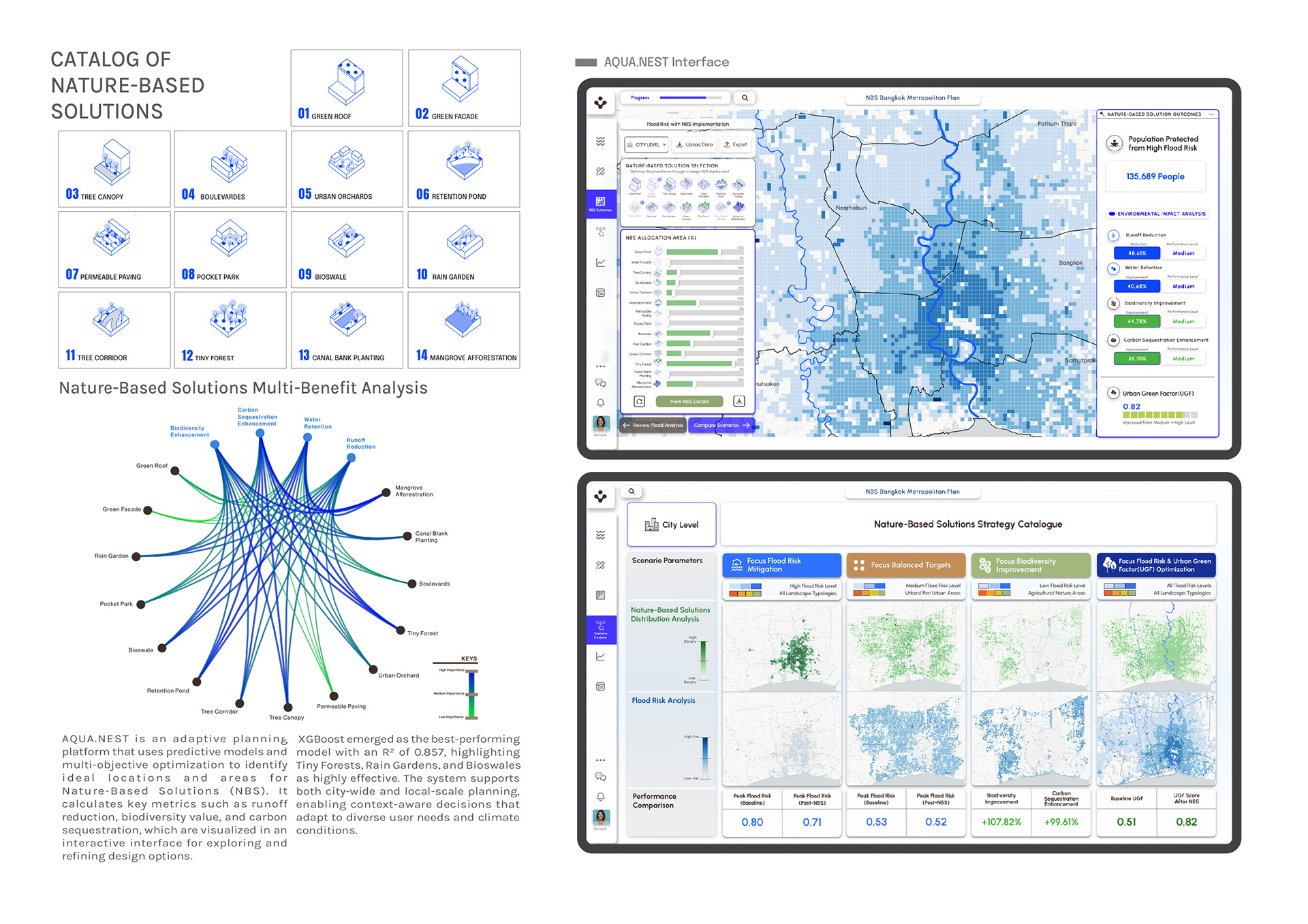
AQUA.NEST adapts to different user needs: urban planners work at the city scale with policy-focused results, while urban designers operate locally with site-specific customization.
Smart Interface Logic
The system guides users through four phases: project setup with flood risk analysis, interactive NBS planning with real-time simulation, results with cost-benefit data, and flexible local optimization for custom areas.
Intelligent Decision Support
Key features include automatic NBS recommendations, compatibility checking that prevents unsuitable selections, and contextual guidance through pop-up explanations. When users make incompatible choices, the system provides immediate feedback and alternatives.
Real-World Impact
The interface transforms complex AI algorithms into intuitive planning tools, allowing users to visualize flood scenarios, compare benefits, and access implementation costs within a single workspace. This bridges sophisticated computational analysis with practical urban design decisions.
.See AQUA.NEST in action: how machine learning recommendations become interactive urban design workflows.
Results & Next Steps
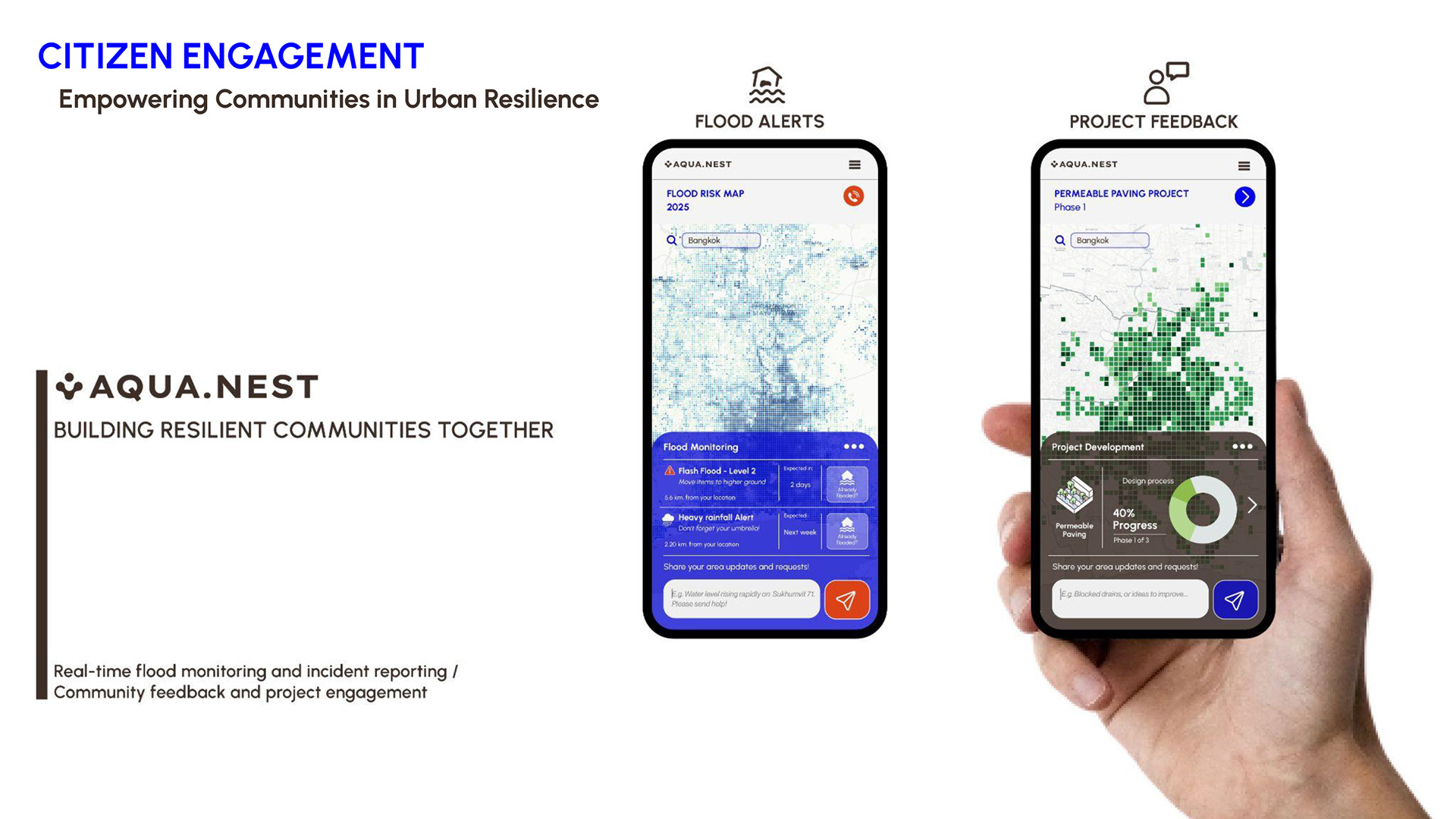
The prototype demonstrates how complex flood risk data, Nature-Based Solution strategies, and predictive modeling can be turned into an accessible decision-making tool. As a future step, the same datasets and machine learning models could power a mobile platform for citizens — providing real-time flood alerts, showcasing ongoing resilience projects, and enabling local participation. This would bridge urban planning solutions directly to the communities they aim to protect.
For research details, read more